Pham Thi Giao Lien
Hai Phong University
Abstract
This article focuses on clarifying the theoretical basis for applying differentiated instruction in teaching literary text reading comprehension. Grounded in reception theory and social constructivism, the paper analyzes three key aspects: (1) the aesthetic and artistic characteristics as well as the multi-layered meanings of literary texts; (2) the naturally hierarchical structure of reading comprehension requirements in the 2018 General Education Curriculum and in international standards (PISA, NAEP); and (3) the diversity of readers and the classroom as an interpretive community. These analyses reveal a reciprocal relationship between differentiated instruction and reading comprehension: the characteristics of literary texts and learner differences form the foundation for differentiating content, process, product, and assessment; conversely, differentiation helps optimize the reading process, fostering students’ critical thinking, literary appreciation, and creative capacity.
Keywords: differentiated instruction, literary text reading comprehension, reading competence, literary reception
1. Introduction
Within a competency-based education approach, literary text reading comprehension is considered a meaning-making process in which readers actively interact with texts and contexts to form understanding, emotions, and values. Rosenblatt’s (1995) transactional theory affirms that reading literature is a “transaction” between the reader and the text, where the reader’s experiences and emotions contribute to creating a unique “lived-through text.” This requires literature classrooms to provide opportunities for multiple readings, multiple layers of interpretation, and respect for individual differences.
From the perspective of modern pedagogy, differentiated instruction (DI) has become an essential approach to accommodate the diversity of students’ readiness, interests, and learning profiles within the same classroom. Tomlinson (1999, 2014) emphasizes that differentiation must be implemented simultaneously in four dimensions: content (what students learn), process (how they learn), product (how they demonstrate learning), and learning environment; all based on three student factors: readiness, interests, and learning profile. This aligns with the goal of the 2018 General Education Curriculum to personalize learning pathways, ensuring that all students progress from their current level toward common learning outcomes.
In current literature teaching practice, students’ proficiency, pace, and reading interest vary widely; however, teaching still tends toward “one standard – one test,” meaning assessments do not fully reflect individual progress. Teachers also lack practical tools for designing differentiated tasks and conducting process-based assessment. In the context of curriculum reform, it is essential to construct a coherent theoretical–practical framework linking the nature of literary texts with instructional design and differentiated assessment.
This article builds on the arguments of both domestic and international scholars to analyze the feasibility of applying differentiated instruction to literary text reading comprehension. It clarifies guiding principles for designing content and learning tasks suited to diverse classrooms, laying a foundation for future applied studies and teaching experiments.
2. Content
2.1. Feasibility of Differentiated Instruction Viewed from the Characteristics of Literary Texts
The aesthetic and artistic nature of literary texts is a key foundation for implementing differentiated instruction. Literary texts are not only artistic linguistic material but also multi-coded, multi-layered structures, opening numerous possibilities for interpretation depending on the reader’s knowledge, experiences, and emotions. This feature allows teachers to design content, procedures, and learning products at various levels, meeting students’ needs, competencies, and interests.
First, the multi-code and multi-layered nature of literary texts forms the basis for differentiated tasks. A literary text contains both linguistic codes (lexis, syntax, genre) and secondary codes (images, symbols, implicit ideas). Teachers can stratify tasks: basic-level students identify characters, plot, and language; more advanced students explore symbolic meaning, analyze artistic devices, and evaluate the text’s ideas.
Second, the coexistence of explicit and implicit information enables deep cognitive reading activities. Tasks may begin with identifying surface details, then advance to inference, real-life connections, critique, and creative interpretation. This approach aligns with Bloom’s taxonomy and international reading assessment frameworks (PISA, NAEP), helping students progress within their “zone of proximal development.”
Third, the openness and plurality of meaning in literary texts allows for diverse learning products. Students may choose to express results through writing responses, drawing illustrations, dramatization, creating videos, or group presentations. Each product becomes a “dialogue” with the text, reflecting diverse receptions and affirming learners’ identities while still achieving common reading competence goals.
The relationship between the characteristics of literary texts and the potential for differentiated instruction can be summarized in the following diagram:
Figure 2.1. Diagram illustrating the relationship between the characteristics of literary texts and the potential for differentiated instruction.
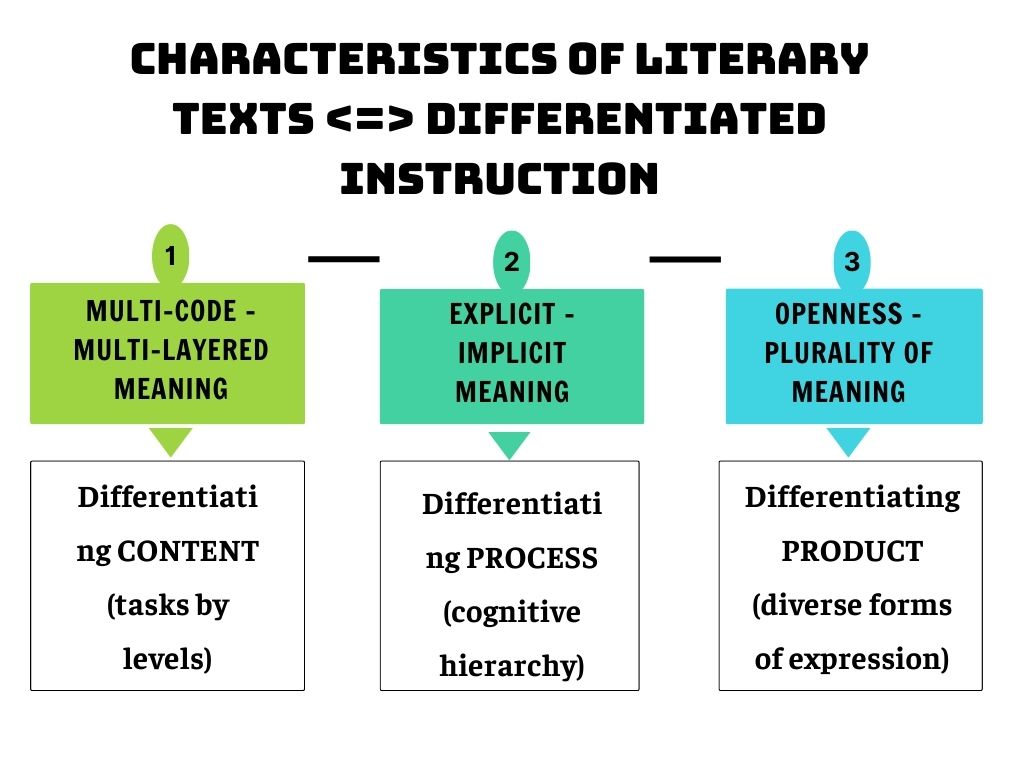
The diagram illustrates that it is precisely thanks to the characteristics of literary texts that teachers can flexibly adjust the content, process, and products to suit different groups of students. This also serves as a stepping stone for examining reading requirements, the learner as reader, and the reading context – factors that will be analyzed in the following sections.
2.2. Feasibility of Differentiated Instruction from Reading Requirements, Readers, and Contexts
Applying differentiated instruction in teaching literary reading is strongly supported when considering three aspects: reading comprehension requirements, the reader as subject, and the reading context – the three key elements shaping the school-based literary reception process.
2.2.1. From Reading Requirements – The Basis for Task Stratification
In the 2018 General Education Curriculum for Literature, reading competence is designed as a hierarchical structure that develops from lower- to higher-order cognitive levels, including: (1) remembering, (2) understanding, (3) applying, (4) analyzing, (5) evaluating, and (6) creating (MOET, 2018). These levels correspond to specific learning operations: identifying information, explaining content, making connections with real-life situations, analyzing artistic and ideological elements, evaluating the text’s value, and creating new content based on the text. This stepwise structure provides a solid pedagogical basis for organizing differentiated learning activities, allowing teachers to design tasks at varying levels that match students’ readiness, abilities, and personal characteristics.
In classroom practice, this can be realized through multi-tiered tasks within the same text. For example, when teaching Dankó’s Heart (Maxim Gorky), students at the basic reception level may only be required to identify key events and describe the character’s actions. More advanced students are asked to analyze the heart symbol and explore the humanitarian value of Dankó’s sacrifice. Gifted students can go further, critiquing the heart symbol from a sociological perspective and comparing Dankó with Prometheus or other cultural heroes.
It is noteworthy that this stratification of reading comprehension requirements is not unique to Vietnam’s curriculum but aligns with global trends in reading literacy assessment. According to PISA, reading literacy is divided into six levels, from Level 1 (locating single, explicit information) to Level 6 (critically evaluating and reflecting on complex, multi-layered information in context). Students at higher levels not only grasp the content but also assess the reliability of information, critique arguments, and solve problems in new situations (OECD, 2018). Similarly, the NAEP (National Assessment of Educational Progress – USA) classifies reading performance into three levels: Basic, Proficient, and Advanced. The Proficient level requires students to draw conclusions, synthesize information, and interpret deeper meanings; whereas the Advanced level demands flexible analysis of symbols, argument structures, and implicit meanings (NCES, 2019).
Thus, both Vietnam’s curriculum and international standards demonstrate that reading comprehension requirements naturally follow a hierarchical structure. This confirms that differentiated instruction is not merely an optional approach but a necessary one to align with modern education’s orientation toward developing multi-dimensional and creative reading competence.
2.2.2. From the Reader – Personalized Reception Characteristics
According to Rosenblatt (1995), the process of reading literature is a “transaction” in which the reader’s knowledge, experience, and emotions co-create a unique “lived-through text” (Rosenblatt, L. M., 1995). This view resonates with Iser’s (1978) theory, which posits that every literary work is an “open structure” that requires the reader’s participation to complete its meaning (Iser, W., 1978). These perspectives affirm the central role of the learner in constructing textual meaning and provide a crucial theoretical basis for applying differentiated instruction to literary reading comprehension.
In actual reading practice, each student is a distinct reader carrying unique life experiences, cognitive capacities, and emotional worlds. No two readers interpret a text in exactly the same way. As a result, reading competence is inherently uneven: some students stop at the surface level, merely reproducing plot and character details; others are capable of uncovering deeper ideological, humanistic, and artistic dimensions. The reading process resembles dropping an anchor into a river—some reach the bottom, others stop halfway—reflecting differences in depth of comprehension and capacity for meaning-making. Such diversity calls for differentiated instruction so that every student can maximize personal potential and make progress along their reading journey.
Reading literary texts involves more than retrieving information; it requires important cognitive operations such as visualization, imagination, inference, comparison, connection, and evaluation. These operations highlight the subjectivity of reception and open up considerable room for personalization within the classroom. For instance, a student who has experienced separation may perceive Xuân Quỳnh’s poem The Boat and the Sea as a poignant love song, whereas another student fond of folklore may read Nam Cao’s Chi Pheo as an “inverted fairy tale.” When skillfully organized and guided, such diversity becomes a valuable resource for differentiated instruction, encouraging each student to develop their own reading style.
Furthermore, reading experience is a dynamic variable, continually enriched and deepened over time. A student who reads Hồ Chí Minh’s Viewing the Scenery in adulthood may interpret it with more depth and serenity than they did in adolescence. This shows that reading ability is not fixed but evolves along with personal growth and life experience. In a single classroom, students may share the same age but differ greatly in background knowledge, life circumstances, and inner worlds. Consequently, reading comprehension instruction must take into account this developmental variability, embodying the principle of differentiation: respecting differences and accompanying personal growth.
The modern literature classroom is no longer a space for “seeking the single truth,” but rather a “community of interpretation,” where multiple readings coexist and complement one another. In a lesson on Phong Điệp’s The Second Floor, some students approach the story from a psychological realism perspective, feeling the mother’s loneliness; others apply a feminist lens to uncover the tragedy of a repressed female self; still others engage in urban criticism, perceiving the emptiness of modern life. These diverse interpretations do not exclude one another but together enrich the reception process.
Figure 2.2. Diagram of the interactive model of literary text reading comprehension under the differentiated instruction approach
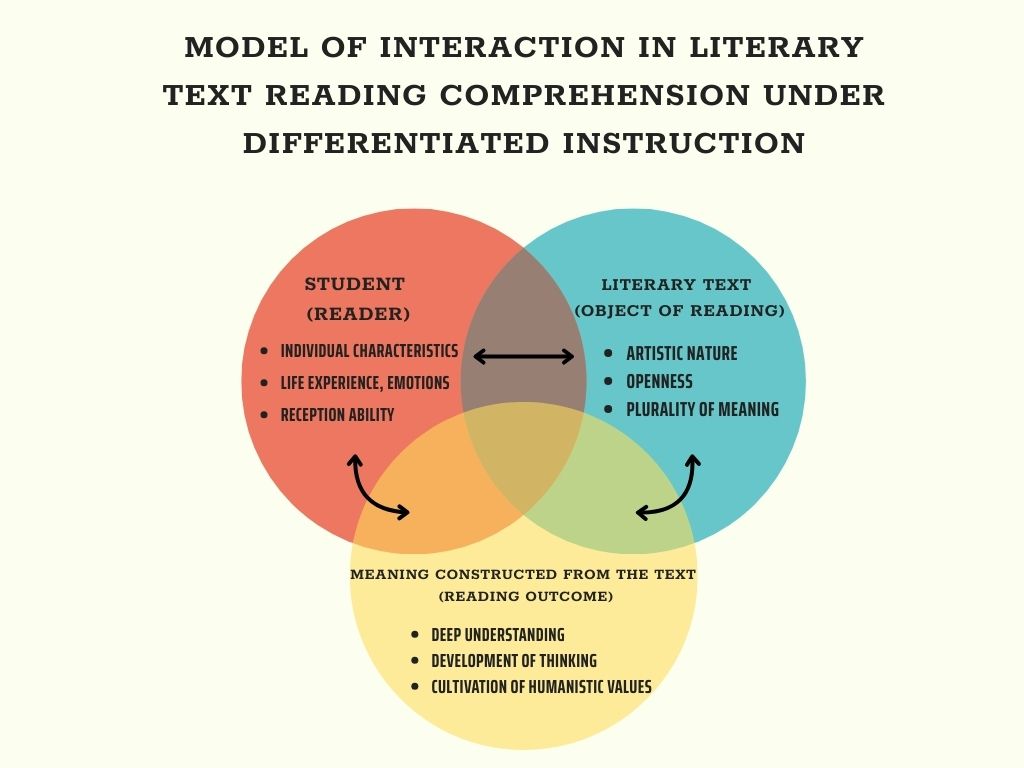
Figure 2.2 illustrates the interactive relationship of three components in teaching literary text reading comprehension under differentiated instruction. The student (the reader) carries individual characteristics, life experiences, emotions, and different levels of reception ability, forming the basis for organizing differentiated instruction. The literary text (the object of reading) is an open artistic whole, rich in aesthetic value and multiple meanings, offering many opportunities for access and interpretation. The meaning of the text (the reading outcome) is the product of this interaction, enabling students to gain deep understanding, develop critical thinking, and nurture humanistic values. The two-way arrows represent the continuous dialogue between the student, the text, and the meaning constructed, turning the literature lesson into an open interpretive community where students both receive and co-create meaning.
From the perspective of personalization, students are not passive recipients but active constructors of meaning, giving each text a “new life” through their own experiences, emotions, and thinking. The diversity of readings transforms the classroom into an open interpretive community, where multiple understandings coexist and complement one another. This provides a solid foundation for implementing differentiated instruction, allowing each student to maximize their individual potential in the process of literary text reading comprehension.
2.2.3. From the Reading Context – An Open Interpretive Community
In the teaching of literary text reading comprehension, the classroom should be regarded as an open interpretive community where students are not merely passive recipients of knowledge but are encouraged to engage in dialogue, share ideas, and co-construct meaning. Unlike the traditional classroom model, which treats literary truth as fixed and absolute, the modern classroom positions each student as a peer reader, entitled to interpret, critique, and construct their own understanding. This approach fosters a rich, polyphonic reception landscape.
Stanley Fish’s (1980) concept of “interpretive communities” asserts that understanding a text is closely tied to the social environment in which readers interact (Fish, S., 1980). Within the classroom, the diversity of students’ life experiences, knowledge, and receptive abilities provides a basis for teachers to design differentiated activities, ensuring that every learner has the opportunity to develop their personal strengths. For example, when teaching Nguyễn Huy Thiệp’s short story Salt of the Jungle, one group of students might discuss human alienation, another focus on the loneliness of the deer, while those with higher-level critical thinking skills might apply psychoanalytic or ecocritical theories to interpret the text.
The classroom as an interpretive community also opens a space for multidimensional dialogue: students interact with the text, with their peers, and with the teacher, forming a continuous exchange of meaning. This reflects Vygotsky’s (1978) social constructivism, which emphasizes that knowledge is constructed through cooperation and communication. Within this context, differentiated instruction becomes a necessity, enabling teachers to optimize individual learning trajectories while maintaining cohesion in the collective learning environment, thereby fostering the holistic development of students.
Figure 2.3. Model of the Impact of Context on Students’ Literary Text
Reading Comprehension

The diagram illustrates the multidimensional relationship among factors influencing students’ literary text reading comprehension. The reading context includes space, time, physical conditions, psychological state, as well as historical–cultural–social background and media influences, functioning as an overarching environment that shapes how texts are received. The teacher plays a guiding role by stimulating interest and emotion, while providing assessment and feedback to help students adjust their learning process. Peers contribute to building an interpretive community through sharing, dialogue, encouragement, and peer evaluation. In addition, teaching materials (curriculum, textbooks, reference sources) provide the official and supporting input. All these factors interact to foster deep reading comprehension competence, develop critical thinking, and cultivate students’ humanistic values.
Across these three dimensions—hierarchical reading requirements, the reader with diverse reception characteristics, and the reading context as a meaning-making environment, it can be affirmed that applying differentiated instruction to teaching literary reading comprehension in secondary schools is both feasible and necessary. Differentiated instruction allows teachers to design multi-level learning tasks that address differences in competence and experience, while optimizing the impact of the classroom context to enhance motivation, engagement, and depth of reception. When requirements, reader, and context are dynamically interconnected, the literature lesson becomes an open dialogue in which students both receive and co-create meaning, develop critical thinking, and nurture humanistic values. This approach aligns with the 2018 General Education Curriculum’s orientation toward competence development and individualized learning, contributing to a more modern model of literature teaching.
3. Conclusion
This article has focused on clarifying the theoretical basis for applying differentiated instruction in teaching literary text reading comprehension. Through the analysis of the aesthetic and artistic characteristics and multi-layered nature of literary texts, the naturally hierarchical structure of reading requirements, the diversity of students’ knowledge, experience, and emotions, and the role of the classroom as an interpretive community, the study affirms that differentiated instruction is not only feasible but also a necessary approach to achieve competence-based educational goals.
These analyses serve as a theoretical orientation, laying the groundwork for designing content, processes, and learning products at multiple levels—addressing individual differences while still aligning with common learning outcomes. The article does not aim to report empirical research or statistical surveys, but to construct a conceptual framework that provides teachers and researchers with a solid basis for designing applied studies, conducting teaching experiments, and developing differentiated assessment in specific classroom contexts.
This approach contributes to shaping a modern model of literature teaching: regarding the literature lesson as an open meaning-making process, where students’ differences are respected, dialogue is encouraged, and co-construction of meaning is fostered. As a result, students develop critical thinking and cultivate humanistic values, in full alignment with the spirit of the 2018 General Education Curriculum.
REFERENCES
- Rosenblatt, L. M. (1995). Literature as Exploration (5th ed.). The Modern Language Association of America.
- Tomlinson, C. A. (1999). The Differentiated Classroom: Responding to the Needs of All Learners. Alexandria, VA: ASCD.
- Tomlinson, C. A. (2014). The Differentiated Classroom: Responding to the Needs of All Learners (2nd ed.). ASCD.
- Ministry of Education and Training [MOET]. (2018). General Education Curriculum – Literature (Promulgated with Circular No. 32/2018/TT-BGDĐT dated December 26, 2018). Hanoi: MOET.
- OECD. (2018). PISA 2018 Assessment and Analytical Framework. OECD Publishing. https://doi.org/10.1787/b25efab8-en.
- National Center for Education Statistics (NCES). (2019). The Nation’s Report Card: Reading 2019. U.S. Department of Education.
https://nces.ed.gov/nationsreportcard.
- Iser, W. (1978). The Act of Reading: A Theory of Aesthetic Response. Johns Hopkins University Press.
- Fish, S. (1980). Is There a Text in This Class? The Authority of Interpretive Communities. Harvard University Press.
- Vygotsky, L. S. (1978). Mind in Society: The Development of Higher Psychological Processes. Harvard University Press.